
If your skin regularly develops pimples, blackheads or whiteheads, it can be tempting to keep adding products until something works. That approach can easily leave you with an irritated skin barrier and an even more confusing routine.
A better starting point is surprisingly simple: cleanse gently, moisturize, protect your skin from the sun, and introduce an acne treatment when you actually need one.
This guide explains how to build a skincare routine for acne-prone skin without turning it into a 10-step regimen. It also covers the difference between salicylic acid and benzoyl peroxide, what to look for when buying products in India, and when skincare alone may not be enough.
This article is independently researched and is not medically reviewed. It is intended for general skincare information, not individual medical advice.
What is the best skincare routine for acne-prone skin?
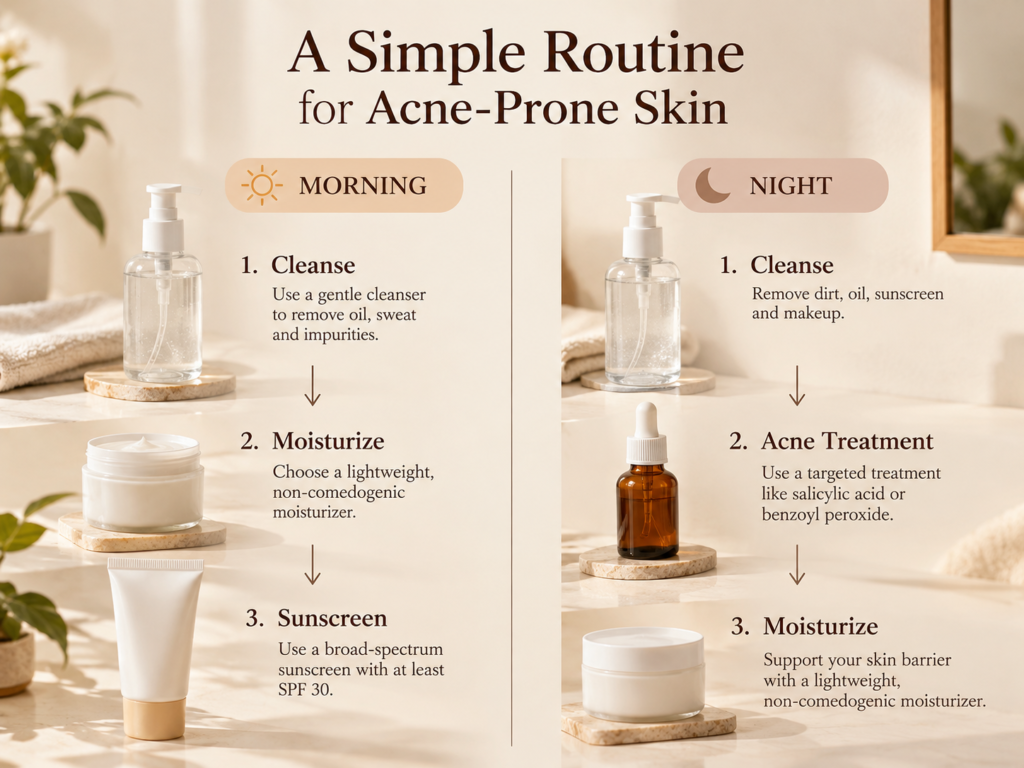
For most beginners, a sensible routine has four basic jobs: clean the skin without excessive irritation, keep it moisturized, protect it from UV exposure, and use an appropriate acne treatment if needed.
A simple starting structure is:
Morning: gentle cleanser → moisturizer → broad-spectrum sunscreen
Night: cleanser → one acne treatment, if appropriate → moisturizer
You don’t necessarily need a different product for every concern. Dermatology guidance emphasizes gentle skincare, non-comedogenic products and avoiding irritation rather than aggressively stripping oily or acne-prone skin.
The order matters too. If you’re unsure where each product fits, here’s our guide to how to layer your skincare products.
Morning skincare routine for acne-prone skin
1. Start with a gentle cleanser
The goal of cleansing is to remove sweat, excess oil, sunscreen and other residue without leaving your skin feeling tight or uncomfortable.
You don’t need to scrub acne away. Mayo Clinic specifically advises avoiding facial scrubs, astringents and excessive washing because irritation can worsen acne.
Before choosing products, it can also help to understand your skin type, since oily, dry, combination and sensitive skin may have different texture and hydration needs.
If you want to use an acne cleanser containing salicylic acid or benzoyl peroxide, remember that this counts as an active treatment. You don’t need to keep adding other exfoliating products simply because your skin is acne-prone.
If you’re looking for a basic cleanser, you don’t necessarily need an acne-treatment cleanser. A gentle, non-comedogenic cleanser like a CeraVe Foaming Cleanser may be a better starting point for a routine that already contains an active treatment.
2. Don’t skip moisturizer because your skin is oily
This is one of the more counterintuitive parts of an acne skincare routine.
Acne treatments such as benzoyl peroxide, salicylic acid and topical retinoids can cause dryness and irritation. The American Academy of Dermatology notes that moisturizer can help skin tolerate these treatments. For acne-prone skin, look for labels such as oil-free, non-comedogenic or “won’t clog pores.”
The right texture depends on your skin and the climate you’re living in. Someone in a hot, humid part of India may prefer a lighter gel or lotion, while someone dealing with dry weather may prefer a more nourishing moisturizer.
Look for a lightweight, non-comedogenic moisturizer if richer creams tend to feel uncomfortable on your skin like Minimalist Vitamin B5 10% Oil-Free Moisturizer
3. Finish with sunscreen
Sunscreen isn’t an acne treatment, but it belongs in the routine.
The American Academy of Dermatology recommends a broad-spectrum, water-resistant sunscreen with SPF 30 or higher and suggests looking for non-comedogenic options for acne-prone skin.
For Indian consumers, texture matters practically. A sunscreen that feels comfortable enough for everyday use is more likely to become a consistent part of your routine, particularly during hot or humid weather.
If you’re prone to breakouts, a non-comedogenic sunscreen like UV Doux Silicone Sunscreen Gel can make the final step easier to stick with.
Night skincare routine for acne-prone skin
Night-time is where an acne treatment can fit into the routine.
Start with the same principle: cleanse gently rather than trying to make your skin feel “squeaky clean.” Then use one targeted acne active if it is suitable for you, followed by moisturizer.
Starting several acne treatments simultaneously makes it difficult to tell which product is helping and which one is irritating your skin. Dermatology guidance also emphasizes keeping the rest of the routine gentle when introducing acne medications.
Salicylic acid vs benzoyl peroxide: what’s the difference?
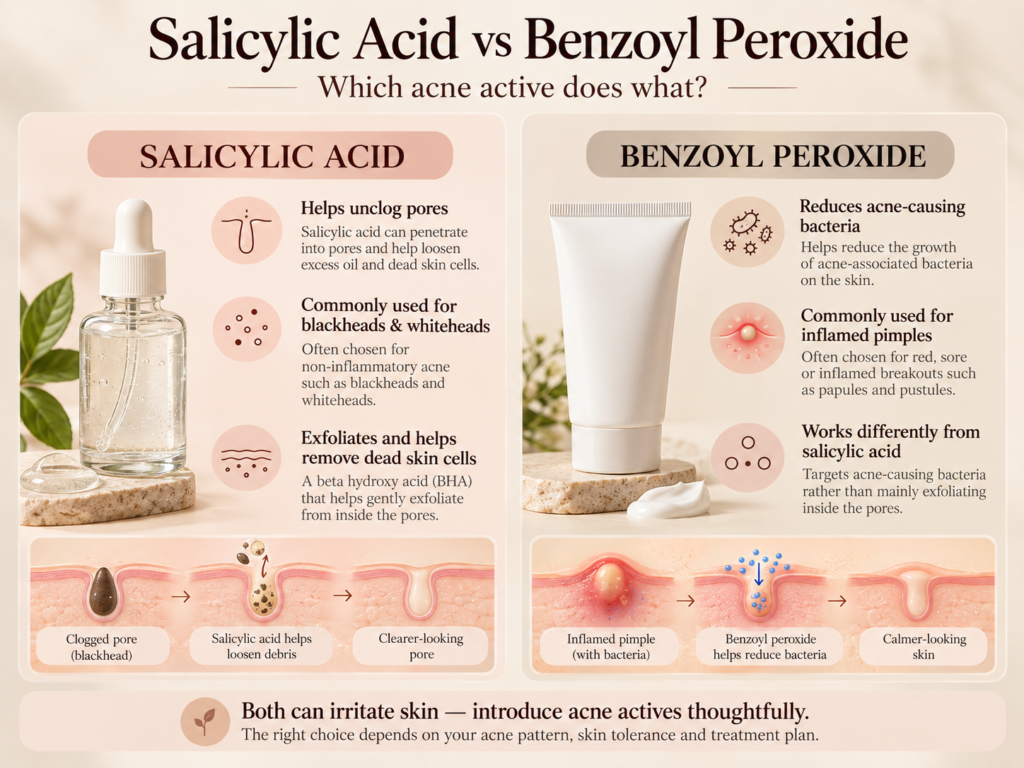
These ingredients aren’t interchangeable, even though both are commonly found in acne products.
If you’re new to skincare actives, our guide to common skincare ingredients can help you understand what different ingredients are designed to do before adding them to your routine.
Salicylic acid helps unclog pores and exfoliate the skin. The AAD says it is particularly useful for whiteheads and blackheads.
The Ordinary Salicylic Acid 2% is a good choice to start with.
Benzoyl peroxide works differently. It reduces acne-associated bacteria on the skin and is commonly used for inflammatory pimples.
That doesn’t mean one is automatically “better.” The more useful question is what type of breakout you’re trying to address and how well your skin tolerates the ingredient.
Benzoyl peroxide can also bleach fabrics, so keep that practical detail in mind when using products containing it.
If you’re unsure which active is appropriate, especially if your acne is persistent or significant, a dermatologist can help determine a suitable treatment rather than having you experiment with multiple products.
What should you look for when buying skincare for acne-prone skin in India?
Product labels can make acne skincare look much more complicated than it needs to be.
For your basic cleanser, moisturizer and sunscreen, look for formulations described as non-comedogenic, oil-free or suitable for acne-prone skin. These labels don’t guarantee that a product will work perfectly for every person, but they can be useful starting points.
For acne treatments, pay more attention to the active ingredient and its formulation than to a long list of marketing claims.
Indian weather is another practical consideration. A heavy cream may feel unpleasant during humid weather, while a very lightweight product may not provide enough comfort during a dry season. Your routine does not need to look identical throughout the year.
You also don’t need to buy an entire “acne kit” just because all the products are marketed together. A basic cleanser, moisturizer and sunscreen can be enough as the foundation, with one treatment active added when appropriate.
Common mistakes that can make an acne routine harder
One of the biggest mistakes is assuming that more irritation means a product is working harder. Burning, excessive dryness, peeling and persistent redness aren’t goals of an effective routine.
Scrubbing is another common problem. Acne isn’t dirt sitting on the surface of your skin, so aggressively scrubbing blemishes won’t solve the underlying problem. Mayo Clinic recommends gentle cleansing and avoiding irritating products.
Picking pimples is worth avoiding too. It can increase irritation and may contribute to scarring.
Finally, resist changing your entire routine every few days. Acne treatments often take time to show an effect, and constantly switching products makes it difficult to work out what your skin actually tolerates.
When should you see a dermatologist for acne?
Skincare can be useful, but not every acne problem should be handled by trial and error with cosmetic products.
Consider professional evaluation if you have painful nodules or cysts, significant acne on areas such as the chest or back, acne that is leaving scars, moderate or severe acne, or breakouts that aren’t improving with appropriate over-the-counter care. NHS guidance also advises seeking medical advice for moderate or severe acne and when pharmacy treatments haven’t controlled it.
A dermatologist can also help if you’re unsure whether what you’re seeing is actually acne. Different skin conditions can produce acne-like bumps, so trying increasingly strong products isn’t always the best next step.
FAQs about skincare routines for acne-prone skin
Should I moisturize if I have acne-prone skin?
Yes. Acne treatments can dry and irritate the skin, and dermatologists may include moisturizer as part of an acne treatment plan. Choose a moisturizer labelled non-comedogenic, oil-free or “won’t clog pores,” and adjust the texture according to how your skin feels.
Can I use salicylic acid and benzoyl peroxide together?
Both are established acne-treatment ingredients, but using multiple actives can increase irritation. Instead of automatically layering them, consider starting with one active and keeping the rest of your routine gentle. If you need a more intensive acne treatment plan, professional guidance can help you choose an appropriate combination.
Do I need sunscreen if I have acne?
Yes. Acne-prone skin still needs sun protection. The AAD recommends broad-spectrum, water-resistant SPF 30 or higher and suggests choosing a non-comedogenic option if you’re prone to breakouts.
How many products do I actually need?
You can start with three basic categories: a gentle cleanser, moisturizer and sunscreen. An acne treatment can then be added according to your needs. A longer routine isn’t automatically a better routine.
A simpler way to think about acne-prone skincare
A good skincare routine doesn’t need to fight your skin at every step.
Build the basics first: gentle cleansing, adequate moisturization and daily sun protection. Then introduce an acne active thoughtfully rather than combining every ingredient you’ve seen recommended online.
For Indian consumers, the best routine is also the one that fits the weather, your skin’s tolerance and your budget well enough to use consistently. And when acne becomes painful, persistent, severe or difficult to manage, the next useful step may not be another serum — it may be a dermatologist.