
Starting skincare actives can feel surprisingly confusing. You see retinol, vitamin C, niacinamide, salicylic acid, glycolic acid and a dozen other ingredients everywhere, and it can start to feel as though a “proper” routine needs several of them at once.
It doesn’t.
If you’re new to active ingredients, the better approach is to introduce them gradually and give yourself enough time to understand how your skin responds. This guide explains how to use actives in skincare, how often to start, why patch testing matters and which signs suggest you’ve gone too far.
If you’re unfamiliar with ingredients such as retinol, vitamin C, niacinamide, salicylic acid or AHAs, our Skincare Ingredients 101 guide explains what these common ingredients are and what they are generally used for.
This article is independently researched and is not medically reviewed. It is intended for general skincare education, not diagnosis or treatment.
What are active ingredients in skincare?
“Active” is a broad skincare term rather than the name of one particular type of ingredient. It generally refers to an ingredient included in a product because it is intended to produce a particular effect on the skin.
Examples include retinol and other retinoids, vitamin C, niacinamide, salicylic acid and alpha hydroxy acids (AHAs) such as glycolic or lactic acid. Different actives have different purposes and different irritation potential.
That distinction matters because you shouldn’t treat all actives as interchangeable. A gentle hydrating ingredient and a strong exfoliating acid don’t belong in the same mental category simply because both are called “actives.”
For example, AHAs chemically exfoliate the skin, while retinoids work through a different mechanism and are commonly used for concerns including acne, uneven pigmentation and visible signs of ageing.
How to use actives in skincare if you’re a beginner
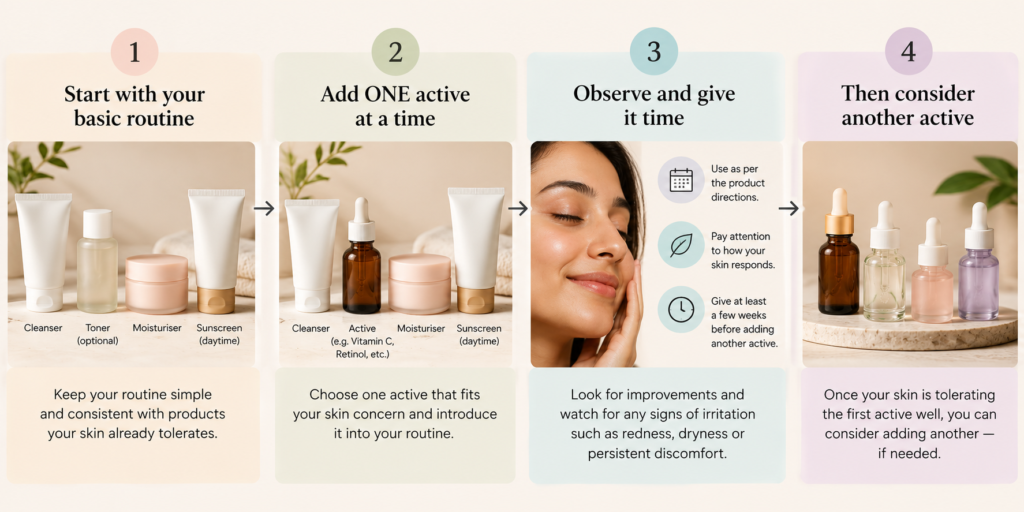
The simplest rule is: don’t change everything at once.
If your current routine is working reasonably well, keep the basics stable and introduce one new active. That way, if your skin becomes dry, itchy, red or uncomfortable, you have a much better chance of identifying what caused the reaction.
If you don’t have a basic routine yet, start there first. Our guide to building a simple skincare routine walks through the essentials before you start adding treatment products.
A simple routine might look like:
Morning:
Cleanser → active, if appropriate for that product → moisturiser → sunscreen
Evening:
Cleanser → active → moisturiser
You don’t necessarily need an active in both routines. The right timing depends on the particular ingredient and product directions.
If you’re still figuring out the order in which your skincare products should go, see our guide to how to layer skincare products correctly.
Start with one active at a time
This is probably the most useful habit for a beginner.
Adding a vitamin C serum, exfoliating acid, retinol and another treatment serum during the same week might make your routine look impressive, but it makes troubleshooting much harder.
There is also a practical reason to resist the temptation. Using several potentially irritating products together can increase the cumulative irritation your skin experiences. The American Academy of Dermatology specifically advises considering the products already in your routine before exfoliating, because combining exfoliating products with retinol, benzoyl peroxide or other irritating products can worsen dryness and irritation.
Give one new active time to become part of your routine before deciding that you need another.
Patch test a new product
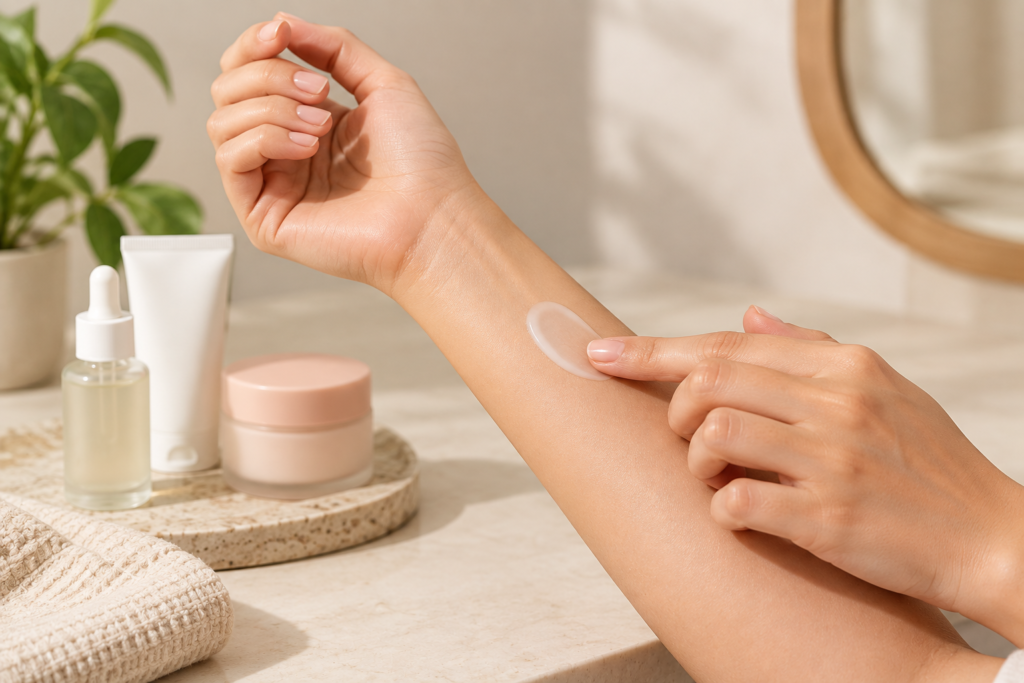
Patch testing is worth doing before putting a new active all over your face.
The American Academy of Dermatology recommends applying a new skincare product to a small test area twice a day for seven to 10 days. The suggested area is somewhere such as the underside of the arm or the bend of the elbow, where the product is less likely to be rubbed or washed away.
This is different from a dermatologist’s formal medical patch test. Formal patch testing is used to investigate suspected allergic contact dermatitis and involves controlled testing of potential allergens.
A home test also isn’t a guarantee that your face will never react. It is simply one sensible precaution when introducing something new.
Follow the product’s directions
More product does not automatically mean better results.
Check the label for how much to apply, whether the product is leave-on or rinse-off, and how frequently the manufacturer says to use it. If an active is particularly irritating, increasing the amount or frequency on your own can make the experience worse rather than faster.
For exfoliating products, the AAD notes that the more aggressive the exfoliation, the less frequently it generally needs to be done, and that over-exfoliation can leave skin red and irritated.
Start gradually
There isn’t one universal starting schedule for every active.
A product’s concentration, formulation, instructions and your skin’s tolerance all matter. Someone beginning a retinoid-based product, for example, may need a different approach from someone adding a mild niacinamide serum.
The general principle is simple: start conservatively, observe your skin and only increase use if the product directions allow it and your skin is tolerating it.
Retinoids are a good example of why this matters. The AAD notes that starting slowly and using moisturiser can help reduce irritation, while topical retinoids commonly cause dryness and irritation when first introduced.
How often should you use skincare actives?
There is no magic number of times per week that applies to every active.
If you’re introducing an exfoliating acid or retinoid, starting less frequently may be appropriate depending on the specific product. A hydrating or otherwise well-tolerated ingredient may be easier for some people to use more regularly.
Read the product instructions rather than copying someone else’s routine from Instagram.
Your skin also gives you useful information. Mild, temporary dryness can occur with some active ingredients, but persistent burning, significant redness, swelling, itching or worsening discomfort are reasons to stop and reassess rather than simply increasing your tolerance.
If you’re repeatedly reacting to products or can’t work out what is causing the reaction, a dermatologist can help identify the problem.
What are the signs you’ve overdone your actives?
Sometimes the problem isn’t the ingredient itself. It’s the combination, frequency or amount.
Watch for skin that becomes unusually:
- red or sore
- dry and flaky
- tight or uncomfortable
- itchy
- persistently burning or stinging
- more sensitive than usual
Irritant reactions can result from the cumulative effect of several irritants. DermNet lists retinoids and benzoyl peroxide among topical products that can cause irritant contact dermatitis, while heat, sweating and friction can also contribute to irritation.
If your skin is clearly irritated, don’t respond by adding another “soothing” active or exfoliating product. Simplifying the routine is often the more sensible first step.
People with darker skin tones should be particularly cautious about irritation because inflammation can sometimes be followed by darker marks. The AAD notes this concern specifically with retinoid irritation and skin of colour.
What should you check before buying an active?
The easiest mistake to make is choosing an ingredient because it is trending rather than because you understand why you’re adding it.
Before buying, ask yourself three questions:
What am I trying to address?
Choose the ingredient based on the concern you’re actually trying to work on, rather than collecting popular serums.
What else is already in my routine?
Check your cleanser, toner, serum, mask and treatment products. You may already be using an exfoliating ingredient without realising it.
Can I realistically use this consistently?
A complicated routine is not automatically a better routine. A product you understand and can use appropriately is more useful than four products competing for space on your bathroom shelf.
For Indian consumers, also check the complete ingredient list, directions, manufacturer information and retailer authenticity before purchasing. Don’t assume that a higher percentage printed on the front of a bottle automatically makes a product more suitable.
Understanding your skin type can also help you make sense of what your skin tends to need. If you’re unsure where you fit, our guide to how to know your skin type can help you start there.
Common mistakes beginners make with skincare actives
One common mistake is starting several actives together because each one appears to solve a different concern. Another is increasing frequency too quickly because the initial results aren’t obvious.
There’s also the idea that burning or peeling proves that a product is “working.” That’s not a useful rule. Irritation can simply mean that your skin is being exposed to more than it can comfortably tolerate.
Over-exfoliating is another easy trap. The AAD advises taking your existing routine into account before adding exfoliation and notes that excessive exfoliation can cause redness and irritation.
Finally, don’t forget sunscreen. FDA guidance notes that topical AHAs can increase sensitivity to sunlight, and recommends sun protection when using them.
Frequently asked questions about starting skincare actives
Can I use more than one active ingredient at a time?
You can sometimes use multiple active ingredients in a routine, but that doesn’t mean you should start with several at once. For a beginner, introducing one new active at a time makes it easier to understand how your skin responds and reduces the confusion that comes with adding multiple potentially irritating products simultaneously.
Should I use an active every day?
Not necessarily. Frequency depends on the ingredient, formulation, concentration and product directions. Some actives can be used more regularly, while exfoliating acids and retinoid products may need a more gradual introduction. Follow the specific product instructions rather than applying a generic schedule to every active.
Is skin peeling a sign that an active is working?
No. Peeling can occur with some active ingredients, but it should not automatically be interpreted as evidence that a product is working. If your skin is persistently irritated, painful, very red or uncomfortable, stop and reassess the product rather than pushing through the reaction.
Can I start retinol and an exfoliating acid together?
For someone new to both, introducing them separately is a more straightforward approach. Retinoids and exfoliating products can both contribute to irritation, and the AAD advises taking existing irritating products into account when adding exfoliation.
Can I use retinoids during pregnancy?
The AAD advises avoiding retinoids during pregnancy. If you’re pregnant, trying to become pregnant or unsure about whether a particular active is appropriate for you, discuss your skincare products with your obstetrician or dermatologist rather than relying on a general skincare routine.
A simpler way to think about starting actives
You don’t need to build an advanced routine overnight.
Start with a basic routine that your skin can tolerate, choose one active for a specific reason, patch test the new product, follow its directions and introduce it gradually. Then give yourself enough time to understand what that product is actually doing before adding something else.
Skincare becomes much easier when you stop treating every new ingredient as something you need immediately. The goal isn’t to fit the maximum number of actives into one routine. It’s to find a routine that makes sense for your skin, your budget and your ability to use it consistently.