
A dry skin routine can still feel confusing at times. You may switch to a richer moisturizer, then add a hydrating serum. If needed, your face may still feel tight or flaky a few hours later.
The solution isn’t necessarily adding more products.
A good dry skin routine usually starts with a few basics: gentle cleansing, regular moisturizing and daily sun protection. Additionally, everything you add after that should have a reason for being there.
This article is independently researched and is not medically reviewed. It is intended for general skincare information, not individual diagnosis or treatment.
Affiliate disclosure: Some links in this article are affiliate links. If you purchase through them, we may earn a small commission at no additional cost to you.
What does dry skin actually need?
Dry skin occurs when the skin loses too much water, which can leave it feeling tight, rough, flaky or uncomfortable. Dermatology guidance focuses on reducing factors that worsen dryness and using moisturizers regularly rather than trying to solve the problem with a long list of products.
For someone starting from scratch, think about the routine as three basic jobs:
Clean gently → moisturize → protect from the sun.
That’s enough to create a useful starting routine.
There is also a distinction worth knowing between dry skin and dehydrated skin. Dry skin is generally related to a lack of oil in the skin, while dehydrated skin refers to insufficient water. The two can overlap, and an article like this cannot determine which one an individual is experiencing.
However, that doesn’t mean you need to diagnose yourself before starting skincare. A gentle routine with regular moisturizing is a sensible place to begin.
Before you start a dry skin routine, it helps to know whether your skin is actually dry or simply dehydrated. If you’re unsure, here’s a simple guide to how to know your skin type.
A simple morning skincare routine for dry skin
A dry-skin routine doesn’t have to take half your morning.
1. Cleanse gently
If your skin feels comfortable when you wake up, you may not need an aggressive morning cleanse.
When you do cleanse, choose something gentle and avoid very hot water. The American Academy of Dermatology recommends gentle cleansing and advises against scrubbing the skin.
Your cleanser should leave your face feeling clean without making it feel unusually tight or uncomfortable.
That “squeaky clean” feeling isn’t something you need to chase.
A gentle, cleanser like a Cetaphil Gentle Skin Hydrating Face Wash may be a good starting point for a routine for dry skin.
2. Apply moisturizer
This is the step worth spending the most thought on when building a dry skin routine.
Moisturizers can contain different types of ingredients that work in different ways. Humectants attract and retain water, emollients help soften and smooth the skin, while occlusives form a layer that helps reduce water loss.
For dry skin, creams and ointments generally provide more moisturizing than lighter lotions. The right texture still depends on how dry your skin is and what you can comfortably use consistently.
Applying moisturizer like Cetaphil Moisturizing Cream while the skin is slightly damp can also help retain moisture.
3. Finish with sunscreen
Dry skin still needs sun protection.
The AAD recommends a broad-spectrum, water-resistant sunscreen with SPF 30 or higher as part of daily sun protection.
If a sunscreen makes your skin feel tight, look for a formula that is comfortable and moisturizing enough for your skin rather than treating sunscreen as an optional step. Try Neutrogena Ultra Sheer Sunscreen for ultra-light and non-shiny finish.
A simple morning routine is:
Gentle cleanser → moisturizer → sunscreen
You don’t need a toner, essence and three serums before you can call this a complete routine.
Not sure which products belong in your morning versus evening routine? Our guide to morning vs. night skincare explains how to separate the two.
A simple night skincare routine for dry skin
Your night routine can be even shorter.
1. Remove sunscreen and makeup
Cleanse gently to remove sunscreen, makeup and the day’s buildup.
If you wear makeup or a particularly resistant sunscreen, you may prefer a separate first cleansing step. The important part is not to compensate for stubborn products by scrubbing your skin aggressively.
The AAD recommends gentle cleansing and patting the skin dry instead of rubbing it.
2. Moisturize
Apply your moisturizer after cleansing, ideally while the skin is still slightly damp.
For noticeably dry skin, a cream may feel more comfortable at night than a lightweight lotion. DermNet notes that creams and ointments are generally more occlusive than lotions, while ointments provide the strongest occlusive effect.
3. Add treatments only when you have a reason
This is where many routines become unnecessarily complicated.
You don’t need to add a serum simply because everyone online seems to have one.
If you eventually want to use an active ingredient for another skin concern, introduce it deliberately and consider how it fits with the rest of your routine.
For dry or easily irritated skin, more activity isn’t automatically better.
If you’re completely new to skincare, start with the basics first. Here’s our guide on how to build a simple skincare routine without making it unnecessarily complicated.
Which ingredients are useful for dry skin?
Instead of looking for a single “best ingredient,” it helps to understand what different ingredient categories actually do.
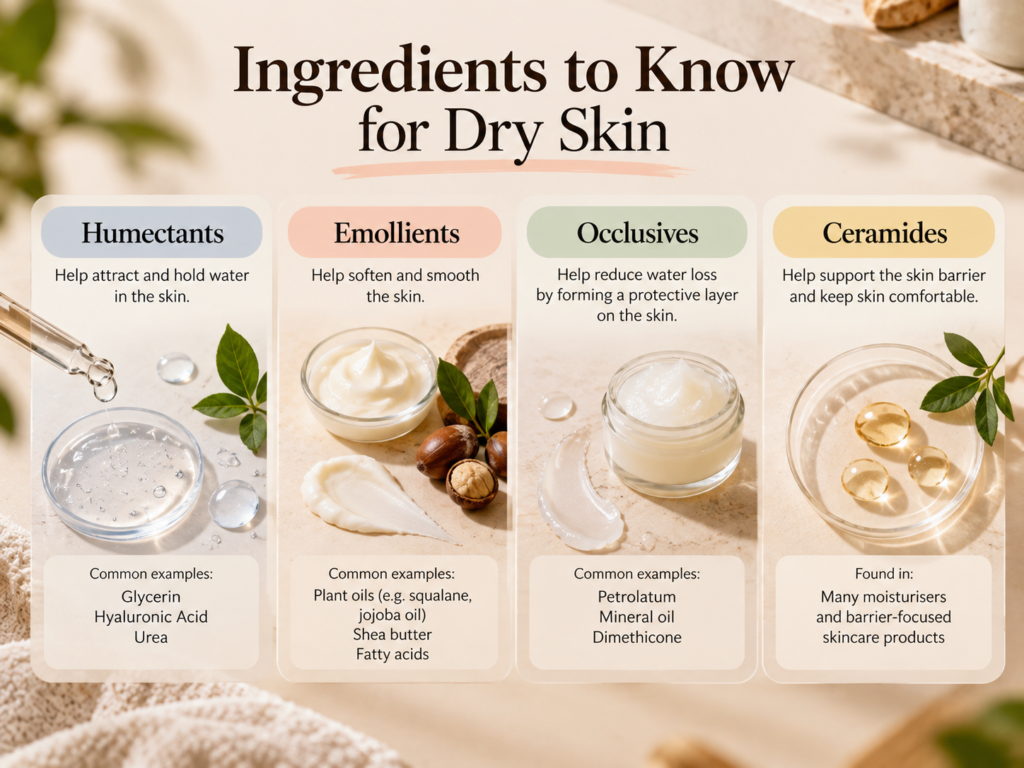
Humectants help attract and hold water
Common examples include glycerin, hyaluronic acid and urea.
Humectants are water-loving ingredients that attract and retain water in the outer layer of the skin.
That makes them useful in products designed to improve hydration, but a humectants isn’t necessarily the entire moisturizing solution. A well-formulated moisturizer may combine humectants with emollients and occlusive.
Emollients help soften and smooth
Emollients contain substances that help soften and smooth the outer layer of the skin.
Different oils and lipid-based ingredients can serve this purpose.
If your skin feels rough or uncomfortable, an emollient-rich moisturizer may feel more comfortable than a very lightweight gel.
Occlusives help reduce water loss
Occlusive ingredients form a protective layer over the skin and help slow evaporation water loss.
Examples include petrolatum, mineral oil and dimethicone.
This is one reason creams and ointments can be useful for very dry skin.
Ceramides are another ingredient worth knowing
Ceramides are lipids found naturally in the skin and are commonly included in moisturizers designed around barrier support.
The AAD lists ceramides among ingredients worth looking for in a moisturizer for dry skin.
The bigger lesson is more useful than memorizing a shopping list: look at the whole formulation rather than assuming one ingredient automatically makes a product suitable for everyone.
Ingredients can be confusing when you’re just starting out. Our beginner’s guide to common skincare ingredients breaks down what they do and how they fit into a routine.
What should you avoid if you have dry skin?
Having dry skin doesn’t mean every active ingredient is permanently off-limits. It does mean that unnecessary irritation isn’t helping.

Very hot water
Long, hot showers can worsen dryness.
The AAD recommends keeping showers short and using warm rather than hot water.
This is an easy change that doesn’t require buying anything.
Harsh cleansing
A strong cleanser followed by aggressive scrubbing isn’t a good strategy for dealing with dry flakes.
DermNet notes that soap, detergents, hot water and other factors can contribute to loss of skin oils and dryness.
Aggressive exfoliation
Flaky skin can make you want to reach for a scrub or acid immediately.
That isn’t necessarily what the skin needs.
The AAD specifically advises against exfoliating dry, peeling skin because it can strip the skin further.
Fragrance if your skin is easily irritated
Fragrance isn’t automatically a problem for every person with dry skin. If your skin is also sensitive or easily irritated, though, fragrance-free products can be a sensible choice.
The AAD recommends fragrance-free products for dry, sensitive skin.
Also pay attention to the wording on packaging. “Unscented” does not necessarily mean fragrance-free.
Too many new products at once
If you introduce a cleanser, serum, exfoliant and new moisturizer in the same week and your skin becomes irritated, it becomes difficult to work out what caused the problem.
Adding products gradually gives you a better chance of understanding what your skin actually tolerates.
How to adapt a dry-skin routine to Indian weather
There isn’t one universal “Indian skin” type.
India includes very different climates and living conditions, from humid coastal areas to drier regions and heavily air-conditioned indoor environments. Your routine may therefore need small adjustments rather than one fixed formula.
In hot and humid weather, a lighter cream may feel more comfortable than a heavy ointment.
In cooler or drier weather, you may prefer a richer cream or need to moisturize more often.
Air conditioning can also make a lightweight moisturizer feel insufficient for some people.
The goal isn’t to automatically choose the thickest product. It’s to find a texture that gives your skin enough comfort and that you will actually use consistently.
This is also where budget matters. You don’t necessarily need a separate summer routine and winter routine with completely different products. Sometimes changing the amount or texture of moisturizer is enough.
Do you really need a serum, toner or exfoliant?
No.
A serum can be useful if you have a specific reason for using one. For example, a hydrating serum containing ingredients such as glycerin or hyaluronic acid can add another layer of hydration.
But if your moisturizer already keeps your skin comfortable, there is no rule saying you need a serum.
The same applies to toner.
Exfoliation deserves more caution. If your skin is already dry, peeling or irritated, adding an exfoliating acid or scrub may not be the smartest next step. The AAD advises against exfoliating dry, peeling skin.
For a beginner, cleanser + moisturizer + sunscreen is a much more useful foundation than a shelf full of products.
Common dry-skin routine mistakes
One common mistake is treating tightness as a sign that the skin needs a stronger cleanse.
It can be tempting to think that a foaming cleanser or scrub is doing a better job, but dryness isn’t something that needs to be “scrubbed away.”
Another mistake is buying an expensive moisturizer while continuing to use products that are irritating the skin. One product can’t necessarily compensate for every other part of the routine.
People also sometimes mistake visible flakes for something that needs immediate exfoliation. If the underlying issue is dryness, aggressive exfoliation can make the skin feel even more uncomfortable.
Then there’s the opposite problem: adding too many hydrating products simply because the routine feels too short.
A short routine isn’t an incomplete routine.
If three well-chosen steps meet your needs, there is no skincare prize for reaching ten.
When persistent dryness needs professional attention
Occasional dryness is common. Persistent or severe dryness is different.
If your skin remains very dry despite making sensible changes, or you experience significant itching, cracking, bleeding, burning, rash or persistent irritation, consider speaking with a dermatologist.
The AAD notes that excessively dry skin can sometimes be associated with underlying conditions, including atopic dermatitis and psoriasis, and recommends professional evaluation when dryness persists or worsens.
A skincare routine can support everyday skin care, but it can’t determine why persistent symptoms are happening.
FAQs about skincare routines for dry skin
What is the best skincare routine for dry skin?
A simple starting routine is a gentle cleanser, a moisturizer suited to dry skin and broad-spectrum sunscreen during the day. At night, cleanse gently and moisturize again. Serums and exfoliants are optional rather than essential.
What ingredients should I look for in a moisturizer for dry skin?
Useful ingredients can include glycerin, hyaluronic acid, ceramides, dimethicone, mineral oil and petrolatum. These ingredients have different roles, so the overall formulation matters more than finding one “best” ingredient.
Should dry skin use sunscreen?
Yes. Dry skin still needs daily sun protection. The AAD recommends broad-spectrum, water-resistant SPF 30 or higher.
Is exfoliation good for dry skin?
Not necessarily. If your skin is already dry, peeling or irritated, aggressive exfoliation may make it more uncomfortable. The AAD specifically advises against exfoliating dry, peeling skin.
How often should I moisturize dry skin?
There isn’t one number that applies to everyone. Moisturize when your skin feels dry, particularly after washing. Very dry skin may require more frequent application.
The simplest way to build your dry-skin routine
You don’t have to buy everything at once.
Start with a gentle cleanser, moisturizer and sunscreen. Give yourself some time to see how your skin feels. If you later identify a specific reason to add a serum or treatment, introduce it deliberately rather than rebuilding the entire routine.
Good skincare isn’t necessarily the routine with the most steps.
For dry skin, a sensible routine is one that cleans gently, moisturizes consistently, protects against the sun and avoids unnecessary irritation.